Compare Private Event IV Therapy Options in Halifax
Compare private event IV therapy formats in Halifax by screening, consent, privacy, venue fit, individual choice, timing and clinical safety questions.
By Pure Drip

Compare Private Event IV Therapy Options in Halifax
Adding a clinical service to a celebration, retreat or workplace gathering changes the planning standard. The host may arrange time and space, but cannot select treatment for guests, guarantee eligibility or turn participation into a social expectation. Every person needs room to ask questions, share relevant health information privately, make an informed choice and decline without pressure.
Pure Drip’s current private-events page presents mobile IV therapy for Halifax gatherings and asks hosts to share the date, guest count, location and service interest before consultations. This establishes an inquiry route; it does not prove that a guest is suitable, confirm ingredients or benefits, or guarantee capacity, price, venue eligibility or outcome.
Use explicit inclusion criteria before comparing formats
This roundup includes a format only if the provider can describe how individual clinical assessment remains separate from event hospitality. The Nova Scotia College of Nursing says its standards apply to registered nurses across practice settings and define professional expectations intended to protect the public. Its medication guidance also connects medication administration to legislation, regulation, policy, individual scope and authorized orders where required.
Those duties do not disappear at a private venue. Ask the provider to explain the responsible professionals, clinical authority, screening, consent, orders, preparation, identification, storage, administration, monitoring, charting, infection prevention, sharps and waste, adverse-event response and follow-up. The answer should be specific to the proposed service and setting.
| Inclusion criterion | What the host should confirm |
|---|---|
| Individual choice | Participation is optional, refusal is private and no organizer chooses for a guest |
| Clinical assessment | A qualified professional evaluates each person and may decline or redirect service |
| Consent and privacy | Questions and health information are handled away from other guests |
| Medication process | Authority, orders, identity, documentation and storage are defined by the provider |
| Venue safety | The space supports privacy, sanitation, lighting, seating, access and emergency response |
| Aftercare | Guests receive instructions, a concern route and emergency guidance appropriate to the service |
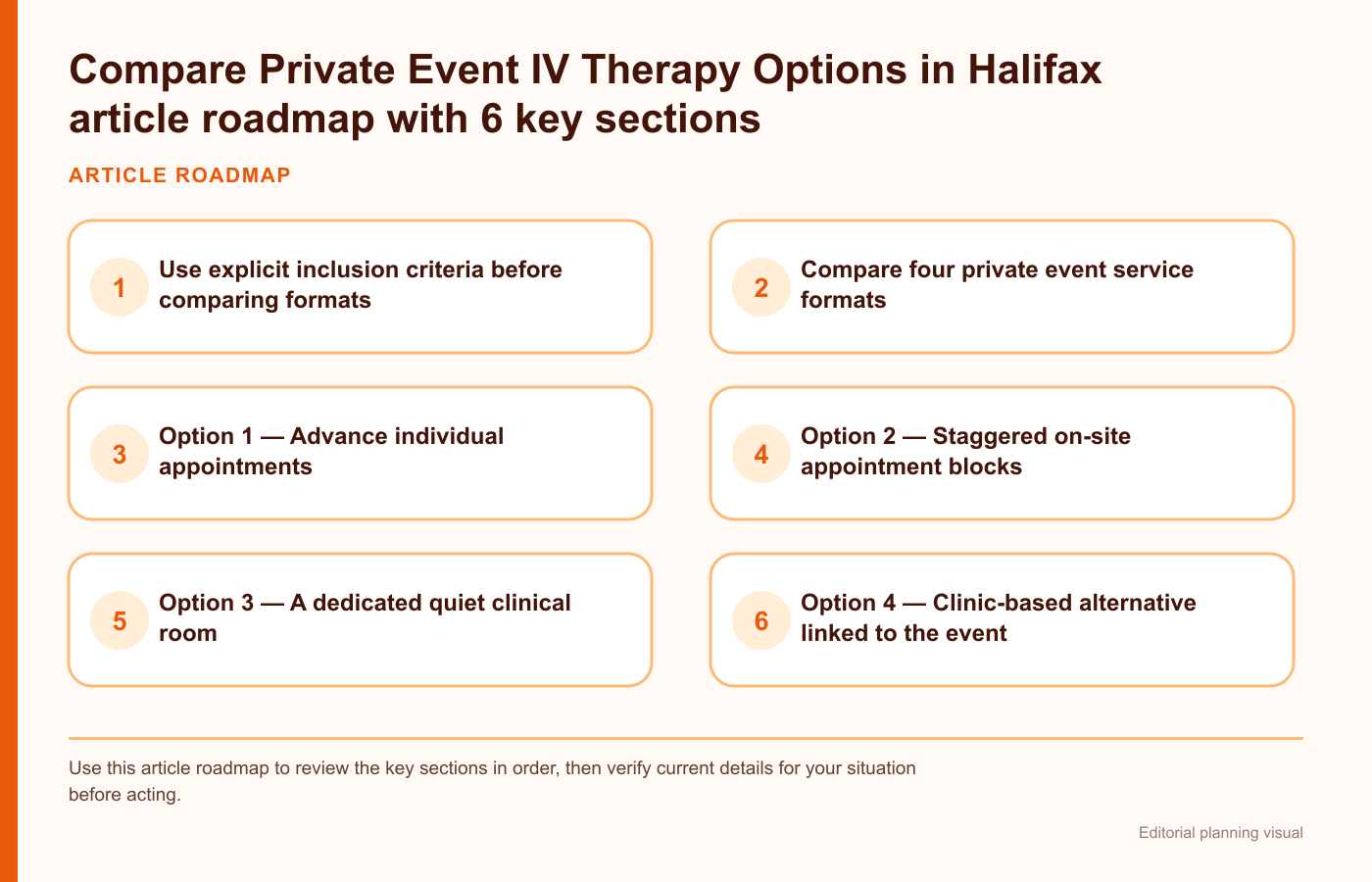
Compare four private event service formats
Option 1 — Advance individual appointments
Guests contact the provider separately before the event and, if the provider considers it appropriate, attend an individual mobile or clinic appointment on another day. This format may suit hosts who want the clinical decision completely separated from the social gathering. It can reduce peer pressure and protect privacy, but it no longer creates a shared on-site amenity. Availability and appropriate timing are clinical and operational matters for the provider.
Option 2 — Staggered on-site appointment blocks
The provider assigns private time windows within a defined event service period. This may suit a venue with a suitable separate room and a schedule that can tolerate guests stepping away. The plan needs buffers for assessment, refusal, delay and clinician decisions. Do not advertise a fixed number of completed services when eligibility and individual choice remain unknown.
Option 3 — A dedicated quiet clinical room
A private room is reserved for consultation and service, away from food, crowds, photography and entertainment. This may suit a larger gathering where confidentiality and a controlled work area cannot be maintained in the main space. The provider must decide whether the room, surfaces, utilities, access and emergency route meet its requirements. A decorative screen in a busy room may not provide meaningful privacy.
Option 4 — Clinic-based alternative linked to the event
Guests make their own appointments at a provider-approved clinic location rather than receiving service at the venue. This may suit an event site that cannot meet the provider’s requirements or a guest who needs a different setting. Pure Drip’s location page presents current location context, but appointment availability and suitability must be confirmed directly.
| Format | Who it may suit logistically | Primary planning question |
|---|---|---|
| Advance individual appointment | Hosts who want care separated from the event | How will the guest contact the provider independently? |
| Staggered on-site blocks | Events with schedule flexibility and a suitable private room | Can timing absorb assessment, refusal and delays? |
| Dedicated clinical room | Larger events able to reserve controlled space | Does the provider approve the room and emergency route? |
| Clinic alternative | Venues that do not fit mobile requirements or guests preferring another setting | What current location and booking options are actually available? |
Verify the clinical and operational workflow
Ask for the legal business name, responsible clinical roles, professional registration information relevant to the service, insurance appropriate to the setting and a written explanation of the prescriber and medication process. Verify credentials with the appropriate regulator rather than relying on an event brochure. Do not infer a scope of practice from the word “nurse” alone; profession, registration, individual competence, orders and setting all matter.
Health Canada advises that all medications carry risk and that people should share medical history and ask about side effects and possible interactions. The provider—not the host—should decide what information is required, protect it appropriately and explain risks, alternatives and aftercare. A guest should know whom to contact with a concern and when emergency care is appropriate.
- Request a written service and venue requirement sheet.
- Confirm who screens, obtains consent, authorizes, prepares, administers, monitors and documents.
- Ask how the provider handles a guest who is not eligible or changes their mind.
- Ask how supplies are transported, secured, identified and removed.
- Review emergency equipment, escalation, access for responders and the nearest appropriate emergency route.
- Confirm incident documentation, aftercare and follow-up responsibilities.
Assess the Halifax venue before inviting guests
Send the provider the full address, event type, expected attendance, floor, parking and loading, stairs or elevator, washroom access, room photos, lighting, water and power availability, temperature conditions, cellular coverage and distance from the entrance. The provider should decide whether an on-site format is operationally and clinically acceptable.
The designated room should be quiet, cleanable, adequately lit and large enough for the provider’s approved seating, work surfaces, supplies and movement. It needs privacy from guests and cameras, a clear exit and an unobstructed path for emergency responders. Children, pets, food service and alcohol should not enter the clinical work zone. Ask how intoxication or other event conditions affect assessment; the host must not make that clinical decision.
Confirm permission from the property owner or venue manager and any applicable venue, building, insurance or operational requirements. Do not assume “mobile” means every home, hotel, workplace or rented hall is eligible.
Protect consent, dignity and health information
An RSVP list should not become a health record. The host may share attendance logistics only with appropriate permission and through the provider’s approved process. Guests should send medical information directly to the provider, not in a group chat, spreadsheet or event registration form controlled by the organizer.
- Use neutral invitation wording that says participation is optional and subject to individual clinician assessment.
- Do not describe anyone as eligible before the provider assesses them.
- Do not offer prizes or social pressure for participation.
- Do not photograph or record the clinical area without specific, valid consent and provider approval.
- Provide a private waiting option that does not reveal whether a guest proceeded or declined.
- Ensure guests can leave the consultation without explaining the decision to the host.
Consent is an ongoing process, not a signature collected by the event planner. A person can ask questions, refuse or withdraw. The clinical professional must decide whether consent is valid and whether the service should proceed.
Know what the event host can and cannot decide
| The host can coordinate | The host should not decide |
|---|---|
| Date, address, venue contact and room access | Whether a guest is medically suitable |
| Guest communication using provider-approved wording | Which product, ingredient, dose or route a guest receives |
| Private room, parking, loading and schedule buffers | Whether a contraindication can be ignored |
| Venue permission and non-clinical event logistics | Whether a professional can work outside scope or without required authority |
| Emergency access information | How a clinical emergency is assessed or treated |
Ask for pricing and cancellation terms in writing, including minimums, deposits, travel, overtime, venue changes, guest changes and what happens when a person does not proceed after assessment. Do not describe a package as “all guests included” when participation and clinical eligibility are individual.
Avoid these private event planning mistakes
- Choosing by a benefit label: marketing language cannot establish an individual need or outcome.
- Collecting health details yourself: it creates avoidable privacy and consent problems.
- Using an open party area: noise, cameras, food and traffic can undermine privacy and workflow.
- Promising service to every guest: assessment, choice and professional judgement may change the count.
- Ignoring alcohol or intoxication: the provider must evaluate how event conditions affect care.
- Skipping credential checks: verify professional information using regulator sources.
- Treating a booking form as informed consent: consent requires appropriate information and capacity at the time.
- Having no emergency route: the venue plan must support timely escalation.
- Using clinical photos as entertainment: protect dignity, privacy and the care environment.
Frequently asked questions
Can an event host choose an IV option for every guest?
No. The host can request logistics information, but each person requires their own provider-led process. Individual assessment, consent, professional judgement and the right to decline remain essential.
Does a private room make any venue suitable?
No. The provider must assess access, surfaces, utilities, privacy, emergency response, surrounding activity and its own clinical requirements. Venue approval cannot be assumed.
What medical information should the host collect?
The host should not design a medical intake. Ask the provider how guests can communicate directly and privately through its approved process. Collect only necessary event logistics with proper permission.
What if a guest feels unwell at the event?
Follow the provider’s instructions and emergency plan. For a medical emergency, call 911. Event IV services are not a substitute for emergency assessment or treatment.
Book the planning conversation before the package
The right first question is not which drip sounds best. It is whether the provider can deliver an optional, private and professionally governed clinical workflow at the proposed location. Once that is clear, the host can compare formats without making medical promises.
Sources reviewed
- Pure Drip private events, about and location — first-party service and inquiry context only.
- Nova Scotia College of Nursing standards for registered nurses — regulator expectations across practice settings.
- NSCN medication guidelines — professional authority, orders and medication-practice context.
- Health Canada medication safety — general risk, interaction and medical-history guidance.